What Is a Dog Pedigree Certificate? A Complete Guide
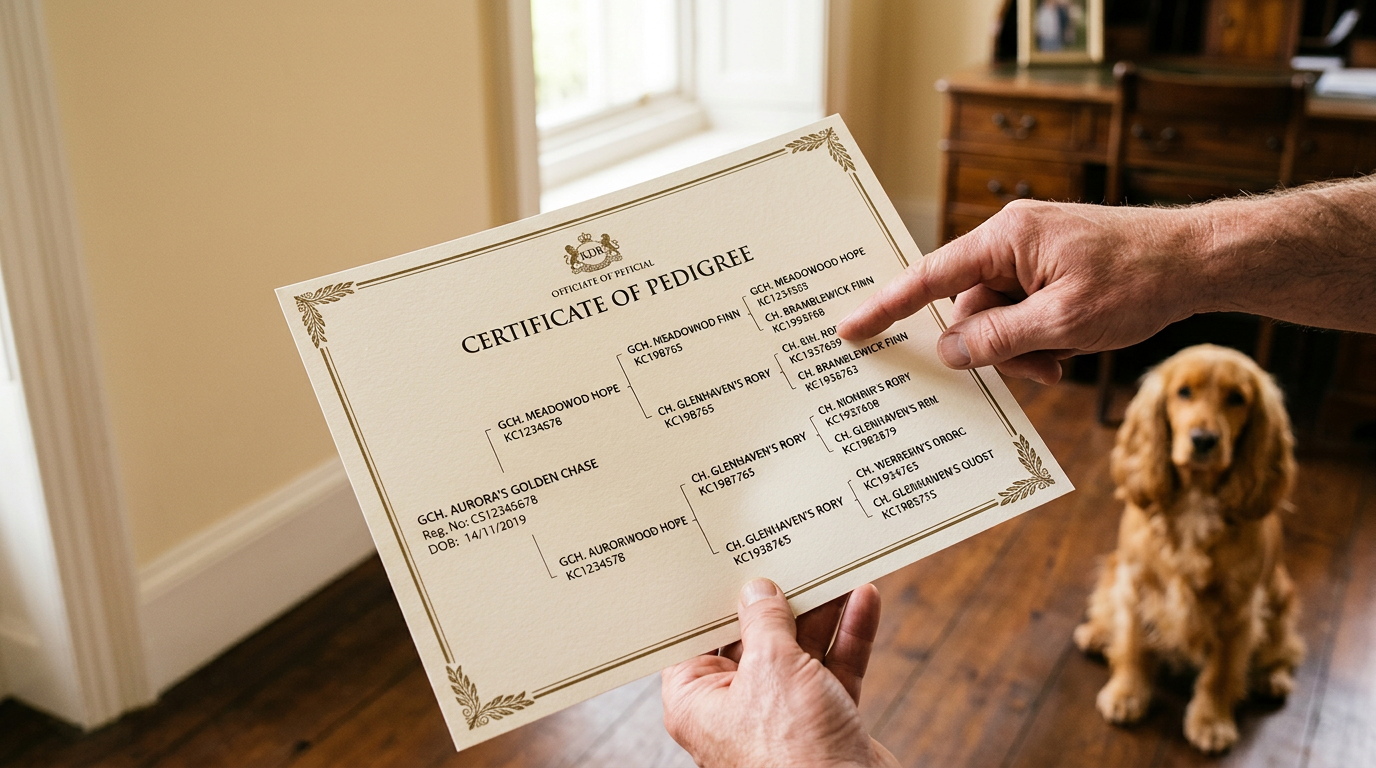
A dog pedigree certificate is an official document that records a dog's ancestry, typically going back three to five generations. It lists the registered names, breeds, and registration numbers of the dog's parents, grandparents, and great-grandparents, and is the standard way to prove that a dog is a genuine example of its breed.
For anyone buying, breeding, or showing a purebred dog, a pedigree certificate is one of the most important documents you can have. This guide explains what a pedigree certificate includes, why it matters, and how you can get one in the UK.
What information is on a dog pedigree certificate?
A standard pedigree certificate shows your dog's family tree in a structured format. While the exact layout varies, most include:
- Your dog's details — registered name, breed, date of birth, registration number, and sometimes colour or sex.
- Sire (father) and dam (mother) — the registered names and numbers of the parents.
- Grandparents and great-grandparents — the same details for each ancestor, usually across three to five generations.
- Titles and awards — any champion or show titles earned by ancestors, often shown as abbreviations next to the dog's name.
- Breeder information — sometimes the original breeder's name and kennel.
In the UK, a Kennel Club pedigree certificate also carries the official Kennel Club logo and a unique reference number, which makes it easy to verify.
Why is a pedigree certificate important?
A pedigree certificate does more than list names. It is proof of a dog's bloodline, and it has practical uses for everyone involved with a purebred dog.
For breeders. A pedigree is essential when planning a litter. It lets you check the ancestry of a potential sire or dam, avoid inbreeding, and assess heritable traits such as hip scores based on the lineage.
For buyers. When you buy a pedigree puppy, the certificate confirms that the dog is registered with a recognised body and that the breeder's claims about its parents and breed are accurate.
For showing and competition. The Kennel Club and most breed clubs require a registered pedigree for entry into breed classes and many working trials.
For value. A dog with a verified pedigree is typically worth more than an unregistered dog of the same breed, because its ancestry is documented and its breeding potential is known.
Kennel Club vs. other pedigree certificates
In the UK, the most widely recognised pedigree certificate is issued by The Kennel Club, the governing body for pedigree dogs. A Kennel Club pedigree is trusted by breeders, vets, and show societies because every entry is cross-checked against the Kennel Club's registration database.
Other countries have their own equivalents, such as the AKC in the United States or the FCI internationally, and the certificate you need depends on where your dog is registered.
A pedigree certificate should not be confused with a certificate of ownership or a vaccination record — those are separate documents. A pedigree specifically documents lineage, not ownership or health.
How do you get a dog pedigree certificate?
There are three common ways to get a pedigree certificate in the UK:
- Buy one from The Kennel Club. If your dog is already registered, you can request an official pedigree directly from the Kennel Club. It is the most trusted option, but it can take time to arrive and the cost adds up if you need certificates for a whole litter.
- Make one yourself. Some owners design a certificate using a template, which is cheaper but requires you to source and check all of the lineage data yourself.
- Generate one digitally. Services like Pup Papers pull your dog's registered details from trusted sources and produce a print-ready PDF in minutes, without you having to re-enter any ancestry data.
For a closer look at the trade-offs between buying from the Kennel Club and making your own, see our comparison of Kennel Club vs. DIY pedigree certificates.
In short
A dog pedigree certificate is the official record of a dog's ancestry. It is the document that proves a purebred dog really is what the breeder says it is, and it is the foundation of any responsible breeding, showing, or buying decision. Whether you get yours from the Kennel Club or generate one digitally, the most important thing is that every name on the certificate is accurate and verifiable.